✨ Search This Blog ✨

Welcomed Visitors

Celtic Music Search Engine

Showing posts with label Celtic Culture. Show all posts

Celtic Cookery : Beltane Bannocks ,Bread, and Other Foods Recipes

The Beltane bonfire festival is really uncomplete without a meal to go along with it. For Beltane, celebrate with foods that honor fertility of the earth. But probably the most widely spread tradition is the one regarding "Scottish Bannocks"

It is is a form of flat bread, the same thickness as a scone cooked on a griddle or fried in a pan. Today it may also be baked in an oven.
Originally made of oatmeal, it takes the form of a large oatcake. Many variations exist, both in Scotland from where it originates and in other countries, like Wales, and USA.

Particularly well-known is the Selkirk bannock, which is more like a fruitcake. Follow this link for further information on this subject

In Scotland, four main variations of bannock were historically tied to the druidic divisions of the year: Imbolc (February 1st), Beltane (May 1st), Lammas (August 1st), and Samhain (October 31st). Thus, special bannocks were made for each of these celebrations.

As Christianity took over, bannocks also became assimilated. The Lammas bannock became the Marymas bannock in honor of the Virgin Mary and the Selkirk bannock became a popular Christmas treat

It's said that if you eat one on Beltane morning, you'll be guaranteed abundance for your crops and livestock. Traditionally, the bannock is made with animal fat (such as bacon grease), and it is placed in a pile of embers, on top of a stone, to cook in the fire. Once it's blackened on both sides, it can be removed, and eaten with a blend of eggs and milk. This recipe doesn't require you to build a fire, and you can use butter instead of fat.

Scottish Bannocks or Oatcakes

Prep Time: 20 minutes
Cook Time: 15 minutes
Total Time: 35 minutes
Ingredients:

* 1 1/2 C oatmeal
* 1/8 tsp. salt
* 1/4 tsp. baking soda
* 1 Tbs. butter
* 1/2 cup hot water

Preparation:

Combine oatmeal, salt and baking soda in a bowl. Melt the butter, and drizzle it over the oats. Add the water, and stir the mix until it forms a stiff dough. Turn the dough out on a sheet of wax paper and knead thoroughly.

Separate the dough into two equal portions, and roll each one into a ball. Use a rolling pin to make a flat pancake that is about ¼" thick. Cook your oatcakes on a griddle over medium heat until they are golden brown. Cut each round into quarters to serve.

Traditionally, the Beltane bannock would have been made with meat fat, such as bacon grease, instead of butter. You can use this if you prefer.

To serve, split the bannocks and spread with butter. They’re excellent with soups or with a big dollop of honey.

Selkirk Bannock

This is unlike the traditional oatcake bannock, more of a fruit cake. It was first made by a baker in Selkirk and was initially only made for festive occasions such as Christmas.


Ingredients:

1 lb flour
8 oz sultanas (seedless white raisins)
4 oz sugar
2 oz butter and 2 oz lard
2 oz chopped mixed peel
Quarter pint milk
Quarter ounce dried yeast
A tablespoon of milk and sugar for the glaze

Method:
Sieve the flour and sugar into a bowl, add the yeast and mix well. Melt the butter and lard in a saucepan on a low heat. Remove as soon as it is melted. Warm the milk in another saucepan and then pour it into the melted fats.

Create a hole in the middle of the flour, sugar and yeast and mix well into a smooth dough. Cover the bowl with a warm, damp towel (or plastic clingfilm) and leave in a warm location for 45 minutes. The dough will rise, doubling in size.

Knead the dough (with flour on your hands to stop it sticking) for five minutes. Add the sultanas and mixed peel and knead well again for another five minutes. Place the dough in a loaf tin and cover with a plastic pollythene bag (tied at the top) and leave in a warm place for 20 minutes to allow it to rise again.

Remove the tin from the bag and bake in a preheated oven at 350F/180C/Gas Mark 4 for an hour. Mix the tablespoon of milk and sugar. Remove the cake tin from the oven and place on a heat-resistant surface. Brush the top with the milk and sugar, using a pastry brush. Return the cake tin to the oven (using oven gloves - it's still hot) and bake for another twenty minutes. Test with a skewer - if it is wet, continue baking for another ten minutes. Remove from the oven and allow to cool before removing. Store in an airtight container.


Beltane Bread

Recipe by Ann Moura (Aoumiel)

Preheat oven to 375 degrees, and combine:
4 cups sifted flour
1/2 cup ground almonds
2 cups sugar
1 tube almond paste
1/2 teaspoon baking powder
1 teaspoon cinnamon
5 eggs

When dough is worked to medium soft, shape into flattened balls and place on ungreased cookie sheet. Bake until golden brown, about 20 minutes. Cool, ice with white Solar Cross. You could try this as a single loaf. I also like to make an almond biscuit with biscuit mix, almond extract, sugar, cinnamon, and eggs, but in smaller proportions. (A lot of my cooking is unmeasured, which doesn't help for making recipes.)

(The above recipe for "Beltane Bread" is directly quoted from Ann Moura (Aoumiel)'s book "Green Witchcraft: Folk Magic, Fairy Lore & Herb Craft", page 218, Llewellyn Publications, 1996.)

Beltaine Cream Pie

Recipe by Edain McCoy

Prepare and pre-bake a pie shell and have it ready in the pie dish. The pie filling will be warmed but not baked.

1 cup whole milk
1 cup rich cream
1/2 cup or one stick of butter (don't use margarine)
3 tablespoons cornstarch
1-1/2 cups sugar
1/14 teaspoon vanilla
ground nutmeg

Melt the butter in a wide cooking pan. (The mixture heats more evenly in this than in a taller more narrow pan Traditionalists will use a heavy cast iron pan.)
In a separate bowl slowly add the milk to the cornstarch making sure it is fully dissolved and absorbed before adding more milk. When the cornstarch is fully blended add this and all the other ingredients, except the vanilla, to the cooking pan.
Stir constantly over medium heat until the mixture becomes thick like a pudding. Remove from heat and stir in the vanilla.
Pour the mixture into the waiting pie shell and sprinkle with nutmeg. the pie may be eaten while it is still warm as long as it has cooled just enough to set. Or the pie may be chilled and eaten later.
(The above recipe for "Beltaine Cream Pie" is directly quoted from Edain McCoy's book "Witta: An Irish Pagan Tradition", page 187, Llewellyn Publications, 1993/1994)


Hereby some further sources and cool links regarding Beltaine Foods:

Merry Imbolc! - Merry Candlemas!

Imbolc (also Imbolg or Oimelc), or Brigid’s Day (Scots Gaelic Là Fhèill Brìghde, Irish Lá Fhéile Bríde, the feast day of St. Brigid), is an Irish festival marking the beginning of spring. Most commonly it is celebrated on February 1 or 2 (or February 12, according to the Old Calendar), which falls halfway between the Winter Solstice and the Spring Equinox in the northern hemisphere.

The festival was observed in Gaelic Ireland during the Middle Ages. Reference to Imbolc is made in Irish mythology, in the Tochmarc Emire of the Ulster Cycle. Imbolc was one of the four cross-quarter days referred to in Irish mythology, the others being Beltane, Lughnasadh and Samhain.
It has been suggested that it was originally a pagan festival associated with the goddess Brigid, who was later Christianised as St. Brigid.


In the 20th century, Imbolc was resurrected as a religious festival in Neopaganism, specifically in Wicca, Neo-druidry and Celtic reconstructionism.

I felt this blog so enlightening that I loved to share it with you...
Originally posted by
Jo Lynne Valerie for her Para Goddess site. All rights reserved by the author.

The lore and traditions are many and varied surrounding this ancient, sacred festival. My own celebration of Imbolc consists of personal traditions I've developed over the years, inspired by ancestral practices, informed by my own Intuition. Keeping the day is to literally celebrate the PROMISE of spring. It's not yet here... but it's coming. And now, during the deepest, darkest leg of winter, when so many of us may be feeling restless or just plain worn out, we need that confirmation more than ever.

The word Imbolc comes from a Gaelic term literally translated to mean "first milk". Now is when sheep and other farm animals begin to lactate; so even though we're in the deepest leg of winter, spring *IS* actually on the way - as indicated by the lactation, which means springtime baby animals are soon to arrive.

This was a powerful sign for our ancestors, folks who lived a life quite different from our own. Imbolc was a harbinger that the hardship of life would ease up. Without grocery stores or malls to rely on, our ancestors had it rough (we think we do... but consider my next words...) By the time February came around, food and wood supplies may have gotten low, or they may have run out completely. Livestock, the elderly and very young children often died this time of year as a result of not enough sustenance, or the cold. These are sobering thoughts. And sobering reminders of how very blessed we are.

While we no longer suffer those particular kinds of hardships, we do face our own challenges in these times, don' we? The deepest leg of the winter brings with it the annual and utterly unavoidable Dark Night of The Soul. Who can escape it? Have you ever tried? Futile. The experience is part and parcel of our soul's evolution, a required passage on the journey we're required to make through the seasons each year.

We're meant to look closely at who we are... and who we want to be. We're meant to look with clear eyes at where we are in life, how far we've come, and where we've fallen short... Where do we want to be? What has worked... and what hasn't? What have we learned? What have we yet to learn? Are we willing?

During the Dark Night of The Soul, individuals are encouraged to retreat into the dark cave of their own being in search of the soul-spark only they can find... that elusive soul-spark only they can see. By its' light, one can discern wisdom, insight, proper choices... Those are the gifts that prompt and fuel our rebirth, come spring. At least, that is the idea; are you game?

Imbolc is essentially one and the same with Candlemas, the mainstream celebration of candles and the "holding of the light". Now you understand the significance!

I like to do four things at Imbolc (Feb 1-2): I like to make a TREASURE MAP (called a vision board by some), ignite as many candles as I have and use these to live by day and night, sans electrical light; I like to bless the seeds I will plant on the Vernal Equinox in March (usually herb and flower seeds) and I like to make a milk-based dish for my daughter to enjoy, usually home-made rice pudding or sometimes my grandmother's bread pudding.

Time allowing, I'll post the recipes for my delicious rice and bread puddings right here on my author's blog (I'm under deadline for print, photo and book work, darlings; give me a little time...). Meanwhile... here are instructions for making a Treasure Map.
❧ IMBOLC TREASURE MAP ❧
Needed: Old magazines you don't mind cutting up, scissors, poster board of any size (a piece of copy paper will do in a pinch), glue stick, imagination.

Instructions: Begin leafing through the magazines in search of images, phrases or words that *speak to you*. Look for pieces that depict who you are, who you want to be, what you love, what you want more of in your life. You can also depict goals, desires or dreams with your images, words and phrases.

Glue them onto your poster board in any manner that is pleasing to your eye. You may further decorate your Treasure Map by coloring, drawing or writing words or phrases on it (I do this with colored pencils). Place the finished Treasure Map in a prominent place; you want to be able to glance at it frequently. It is, after all, the map that can lead you to your own personal treasure... that is, if you are willing to follow the trail.

Happy Imbolc, everyone. A blessed Candlemas to you. Light a candle today... or five, or ten. Let the flames illuminate the beauty in your heart and the fierceness of your dreams. Let the light spark your soul alive... And bless yourself, my friends... for all that you are and all you will yet be.
When the tides turn and the spring winds blow, we will emerge renewed, rebirthed, together.
Love always from your ParaGoddess...
Love, love, the most important thing is love... -JoLynne

Browsing The Halloween Celebrations


Hi to all! We are closer to the Celtic New Year!...as the like of a hide and seek... I decided not to compose a review but to browse the web in search of data related to our celtic Samhain..."End of Summer," a pastoral and agricultural "fire festival" or feast, when the dead revisited the mortal world and large communal bonfires would hence be lit to ward off evil spirits. I hit up by chance...and found out this cute blog which is quite accurate to my believes and conceptions ...
...The Fantasy and Folklore of All Hallows by Jack Santino (all rights reserved by the author)

"Halloween had its beginnings in an ancient, pre-Christian Celtic festival of the dead. The Celtic peoples, who were once found all over Europe, divided the year by four major holidays. According to their calendar, the year began on a day corresponding to November 1st on our present calendar. The date marked the beginning of winter. Since they were pastoral people, it was a time when cattle and sheep had to be moved to closer pastures and all livestock had to be secured for the winter months. Crops were harvested and stored. The date marked both an ending and a beginning in an eternal cycle.

The festival observed at this time was called Samhain (pronounced Sah-ween). It was the biggest and most significant holiday of the Celtic year. The Celts believed that at the time of Samhain, more so than any other time of the year, the ghosts of the dead were able to mingle with the living, because at Samhain the souls of those who had died during the year traveled into the otherworld. People gathered to sacrifice animals, fruits, and vegetables. They also lit bonfires in honor of the dead, to aid them on their journey, and to keep them away from the living. On that day all manner of beings were abroad: ghosts, fairies, and demons--all part of the dark and dread.

Samhain became the Halloween we are familiar with when Christian missionaries attempted to change the religious practices of the Celtic people. In the early centuries of the first millennium A.D., before missionaries such as St. Patrick and St. Columcille converted them to Christianity, the Celts practiced an elaborate religion through their priestly caste, the Druids, who were priests, poets, scientists and scholars all at once. As religious leaders, ritual specialists, and bearers of learning, the Druids were not unlike the very missionaries and monks who were to Christianize their people and brand them evil devil worshippers.

As a result of their efforts to wipe out "pagan" holidays, such as Samhain, the Christians succeeded in effecting major transformations in it. In 601 A.D. Pope Gregory the First issued a now famous edict to his missionaries concerning the native beliefs and customs of the peoples he hoped to convert. Rather than try to obliterate native peoples' customs and beliefs, the pope instructed his missionaries to use them: if a group of people worshipped a tree, rather than cut it down, he advised them to consecrate it to Christ and allow its continued worship.

In terms of spreading Christianity, this was a brilliant concept and it became a basic approach used in Catholic missionary work. Church holy days were purposely set to coincide with native holy days. Christmas, for instance, was assigned the arbitrary date of December 25th because it corresponded with the mid-winter celebration of many peoples. Likewise, St. John's Day was set on the summer solstice.

Samhain, with its emphasis on the supernatural, was decidedly pagan. While missionaries identified their holy days with those observed by the Celts, they branded the earlier religion's supernatural deities as evil, and associated them with the devil. As representatives of the rival religion, Druids were considered evil worshippers of devilish or demonic gods and spirits. The Celtic underworld inevitably became identified with the Christian Hell.

The effects of this policy were to diminish but not totally eradicate the beliefs in the traditional gods. Celtic belief in supernatural creatures persisted, while the church made deliberate attempts to define them as being not merely dangerous, but malicious. Followers of the old religion went into hiding and were branded as witches.

The Christian feast of All Saints was assigned to November 1st. The day honored every Christian saint, especially those that did not otherwise have a special day devoted to them. This feast day was meant to substitute for Samhain, to draw the devotion of the Celtic peoples, and, finally, to replace it forever. That did not happen, but the traditional Celtic deities diminished in status, becoming fairies or leprechauns of more recent traditions.

The old beliefs associated with Samhain never died out entirely. The powerful symbolism of the traveling dead was too strong, and perhaps too basic to the human psyche, to be satisfied with the new, more abstract Catholic feast honoring saints. Recognizing that something that would subsume the original energy of Samhain was necessary, the church tried again to supplant it with a Christian feast day in the 9th century. This time it established November 2nd as All Souls Day--a day when the living prayed for the souls of all the dead. But, once again, the practice of retaining traditional customs while attempting to redefine them had a sustaining effect: the traditional beliefs and customs lived on, in new guises.

All Saints Day, otherwise known as All Hallows (hallowed means sanctified or holy), continued the ancient Celtic traditions. The evening prior to the day was the time of the most intense activity, both human and supernatural. People continued to celebrate All Hallows Eve as a time of the wandering dead, but the supernatural beings were now thought to be evil. The folk continued to propitiate those spirits (and their masked impersonators) by setting out gifts of food and drink. Subsequently, All Hallows Eve became Hallow Evening, which became Hallowe'en--an ancient Celtic, pre-Christian New Year's Day in contemporary dress.

Many supernatural creatures became associated with All Hallows. In Ireland fairies were numbered among the legendary creatures who roamed on Halloween.

An old folk ballad called "Allison Gross" tells the story of how the fairy queen saved a man from a witch's spell on Halloween.

O Allison Gross, that lives in yon tower
the ugliest witch int he North Country...
She's turned me into an ugly worm
and gard me toddle around a tree...
But as it fell out last Hallow even
When the seely [fairy] court was riding by,
the Queen lighted down on a gowany bank
Not far from the tree where I wont to lie...
She's change me again to my own proper shape
And I no more toddle about the tree.

In old England cakes were made for the wandering souls, and people went "a' soulin'" for these "soul cakes." Halloween, a time of magic, also became a day of divination, with a host of magical beliefs: for instance, if persons hold a mirror on Halloween and walk backwards down the stairs to the basement, the face that appears in the mirror will be their next lover.

Virtually all present Halloween traditions can be traced to the ancient Celtic day of the dead. Halloween is a holiday of many mysterious customs, but each one has a history, or at least a story behind it. The wearing of costumes, for instance, and roaming from door to door demanding treats can be traced to the Celtic period and the first few centuries of the Christian era, when it was thought that the souls of the dead were out and around, along with fairies, witches, and demons. Offerings of food and drink were left out to placate them. As the centuries wore on, people began dressing like these dreadful creatures, performing antics in exchange for food and drink. This practice is called mumming, from which the practice of trick-or-treating evolved. To this day, witches, ghosts, and skeleton figures of the dead are among the favorite disguises. Halloween also retains some features that harken back to the original harvest holiday of Samhain, such as the customs of bobbing for apples and carving vegetables, as well as the fruits, nuts, and spices cider associated with the day.

Today Halloween is becoming once again and adult holiday or masquerade, like mardi Gras Men and women in every disguise imaginable are taking to the streets of big American cities and parading past grinningly carved, candlelit jack o'lanterns, re- enacting customs with a lengthy pedigree. Their masked antics challenge, mock, tease, and appease the dread forces of the night, of the soul, and of the otherworld that becomes our world on this night of reversible possibilities, inverted roles, and transcendency. In so doing, they are reaffirming death and its place as a part of life in an exhilarating celebration of a holy and magic evening. "

For those interested in tradition and history on Celtic Countries take a look at http://en.wikipedia.org/wiki/Halloween
http://en.wikipedia.org/wiki/Samhain


FREE APP PREVIEW by Celtic Radio

Visit Celtic Radio
FREE APP PREVIEW

user posted image

user posted image


I am pleased to announce a free preview of two of these premium channels on the Celtic Radio Network App.

Celtic Moon offers An Exquisite Mix of Soft Irish, Scottish & Celtic Music. Perfect for night time listening when you desire the softer side of Celtic Music.

Ye Ol'Celtic Pub is where the fish and chips are hot and the tunes are from days past like the Clancy Brothers, The Irish Rovers and the Dubliners. Pull up a chair and a glass of Guinness to remember the way Celtic music was meant to be played.

Now available through the Basic Listening Option on the Celtic Radio Network App for the next few weeks. Download the App with the following links and enjoy!
Do you really like our App? Then give them a rating in the App Store or Google Play store. Much appreciated! :)


user posted image

user posted image

user posted image

user posted image

Faerie Lore : Fairy Gifts - Compiled by Wirt Sikes (1880)

Posted from the book "British Goblins - Welsh Folk-lore, Fairy Mythology, Legends and Traditions by Wirt Sikes - [1880] " (Obtain this full work and many more backups by clicking here!)

Chapter X
Fairy Money and Fairy Gifts in General The Story of Gitto Bach, or Little Griffith--The Penalty of Blabbing--Legends of the Shepherds of Cwm Llan--The Money Value of Kindness--Ianto Llewellyn and the Tylwyth Teg--The Legend of Hafod Lwyddog--Lessons inculcated by these Superstitions.

I.
'THIS is fairy gold, boy, and 'twill prove so, says the old shepherd in 'Winter's Tale;' sagely adding, 'Up with it, keep it close; home, home, the next way We are lucky, boy, and to be so still, requires nothing but secrecy.' ['Winter's Tale,' Act III., Sc. 3.] Here we have the traditional belief of the Welsh peasantry in a nut-shell. Fairy money is as good as any, so long as its source is kept a profound secret; if the finder relate the particulars of his good fortune, it will vanish. Sometimes--especially in cases where the money has been spent--the evil result of tattling consists in there being no further favours of the sort The same law governs fairy gifts of all kinds. A Breconshire legend tells of the generosity of the Tylwyth Teg in presenting the peasantry with loaves of bread, which turned to toadstools next morning; it was necessary to eat the bread in darkness and silence to avoid this transformation. The story of Gitto Bach, a familiar one in Wales, is a picturesque example. Gitto Bach (little Griffith), a good little farmer's boy of Glamorganshire, used often to ramble to the top of the mountain to look after his father's sheep. On his return he would show his brothers and sisters pieces of remarkably white paper, like crown pieces, with letters stamped upon them, which he said were given to him by the little children with whom he played on the mountain. One day he did not return. For two years nothing was heard of him. Meantime other children occasionally got like crown-pieces of paper from the mountains. One morning when Gitto's mother opened the door there he sat-the truant -dressed exactly as he was when she saw him last, two years before. He had a little bundle under his arm. 'Where in the world have you been all this time?' asked the mother. 'Why, it's only yesterday I went away!' quoth Gitto. 'Look at the pretty clothes the children gave me on the mountain, for dancing with them to the music of their harps.' With this he opened his bundle, and showed a handsome dress; and behold, it was only paper, like the fairy money.
II.
But usually, throughout Wales, it is simply a discontinuance of fairy favour which follows blabbing. A legend is connected with a bridge in Anglesea, of a lad who often saw the fairies there, and profited by their generosity. Every morning, w
hile going to fetch his father's cows from pasture, he saw them, and after they were gone he always found a groat on a certain stone of Cymmunod Bridge. The boy's having money so often about him excited his father's suspicion, and one Sabbath day he cross-questioned the lad as to the manner in which it was obtained. Oh, the meddlesomeness of fathers! Of course the poor boy confessed that it was through the medium of the fairies, and of course, though he often went after this to the field, he never found any money on the bridge, nor saw the offended Tylwyth Teg again. Through his divulging the secret their favour was lost.
Jones tells a similar story of a young woman named Anne William Francis, in the parish of Bassalleg, who on going by night into a little grove of wood near the house, heard pleasant music, and saw a company of fairies dancing on the grass. She took a pail of water there, thinking it would gratify them. The next time she went there she had a shilling given her, 'and so had for several nights after, until she had twenty-one shillings.' But her mother happening to find the money, questioned her as to where she got it, fearing she had stolen it. At first the girl would not tell, but when her mother 'went very severe on her,' and threatened to beat he?, she confessed she got the money from the fairies. After that they never gave her any more. The Prophet adds: ' I have heard of other places where people have had money from the fairies, sometimes silver sixpences, but most commonly copper coin. As they cannot make money, it certainly must be money lost or concealed by persons.' The Euhemerism of this is hardly like the wonder-loving Jones.
III.
In the legends of the two shepherds of Cwm LIan and their experience with the fairies, the first deals with the secrecy feature, while the second reproduces the often impressed lesson concerning the money value of kindness. The first i
s as follows: One evening a shepherd, who had been searching for his sheep on the side of Nant y Bettws, after crossing Bwlch Cwm LIan, espied a number of little people singing and dancing, and some of the prettiest damsels he ever set eyes on preparing a feast. He went to them and partook of the meal, and thought he had never tasted anything to equal those dishes. When it became dusk they pitched their tents, and the shepherd had never seen before such beautiful things as they had about them there. They provided him with a soft feather-bed and sheets of the finest linen, and he retired, feeling like a prince. But on the morrow, lo and behold! his bed was but a bush of bulrushes, and his pillow a tuft of moss. He however found in his shoes some pieces of silver, and afterwards, for a long time he continued to find once a week a piece of silver; placed between two stones near the spot where he had lain. One day he divulged his secret to another, and the weekly coin was never placed there again.
There was another shepherd near Cwm Llan, who heard some strange noise in a crevice of a rock, and turning to see what it was, found there a singular creature who wept bitterly. He took it out and saw it to be a fairy child, but whilst he was looking at it compassionately, two middle-aged men came to him and thanked him courteously for his kindness, and on leaving him presented him with a staff as a token of remembrance of the occasion. The following year every sheep he possessed bore two ewe lambs. They continued to thus breed for years to come; but one very dark and stormy night, having stayed very late in the village, in crossing the river that comes down from Cwm Llan, there being a great flood sweeping everything before it, he dropped his staff into the river and saw it no more. On the morrow he found that nearly all his sheep and lambs, like his staff, had been swept away by the flood. His wealth had departed from him in the same way as it came-with the staff which he had received from the guardians of the fairy child.
IV.
A Pembrokeshire Welshman told me this story as a tradition well known in that part of Wales. Ianto Llewellyn was a man who lived in the parish of Llanfihangel, not more than fifty or eighty years ago, and who had precious good reason to believe in the fairies. He used to keep his fire of coal balls burning all night long, out of pure kindness of heart, in case the Tylwyth Teg should be cold. That they came into his kitchen every night he was well aware; he often heard them. One night when they were there as usual, lanto was lying wide awake and heard them say, 'I wish we had some good bread and cheese this cold night, but the poor man has only a morsel left; and though it's true that would be a good meal for us, it is but a mouthful to him, and he might starve if we took it.' At this lanto cried out at the top of his voice, 'Take anything I've got in my cupboard and welcome to you!' Then he turned over and went to sleep. The next morning, when he descended into the kitchen, he looked in his cupboard, to see if by good luck there might be a bit of crust there. He had no sooner opened the cupboard door than he cried out, 'O'r anwyl! what's this?' for there stood the finest cheese he had ever seen in his life, with two loaves of bread on top of it 'Lwc dda i ti!' cried lanto, waving his hand toward the wood where he knew the fairies lived; 'good luck to you! May you never be hungry or penniless!' And he had not got the words out of his mouth when he saw--what do you think?--a shilling on the hob! But that was the lucky shilling. Every morning after this, when lanto got up, there was the shilling on the hob another one, you mind, for he'd spent the first for beer and tobacco to go with his bread and cheese. Well, after that, no man in the parish was better supplied with money than lanto Llewellyn, though he never did a stroke of work. He had enough to keep his wife in ease and comfort, too, and he got the name of Lucky lanto. And lucky he might have been to the day of his death but for the curiosity of woman. Betsi his wife was determined to know where all this money came from' and gave the poor man no peace. 'Wel, naw wfft!' she cried--which means in English, 'Nine shames on you '--' to have a bad secret from your own dear wife!' 'But you know, Betsi, if I tell you I'll never get any more money.' ' Ah,' said she, ' then it's the fairies!' 'Drato!' said he--and that means 'Bother it all '--' yes--the fairies it is.' With that he thrust his hands down in his breeches pockets in a sullen manner and left the house. He had had seven shillings in his pockets up to that minute, and he went feeling for them with his fingers, and found they were gone. In place of them were some pieces of paper fit only to light his pipe. And from that day the fairies brought him no more money.
V.
The lesson of generosity is taught with force and simplicity in the legend of Hafod Lwyddog, and the necessity for secrecy is quite abandoned. Again it is a shepherd, who dwelt at Cwm Dyli, and who went every summer to live in a cabin by the Green Lake (Llyn Glas) along with his fold. One morning on awaking from sleep he saw a good-looking damsel dressing an infant close by his side. She had very little in which to wrap the babe, so he threw her an old shirt of his own, and bade her place it about the child. She thanked him and departed. Every night thereafter the shepherd found a piece of silver placed in an old clog in his cabin. Years and years this good luck continued, and Meirig the shepherd became immensely wealthy. He married a lovely girl, and went to the Hafod Lwyddog to live. Whatever he undertook prospered--hence the name Hafod Lwyddog, for Lwydd means prosperity. The fairies paid nightly visits to the Hafod. No witch or evil sprite could harm this people, as Bendith y Mammau was poured down upon the family, and all their descendants. ['Cymru Fu,' 472]
VI.
The thought will naturally occur that by fostering belief in such tales as some of the foregoing, roguery might make the superstition useful in silencing inquiry as to ill-gotten gains. But on the other hand the virtues of hospitality and generosity were no doubt fostered by the same influences. If any one was favoured by the fairies in this manner, the immediate explanation was, that he had done a good turn to them, generally without suspecting who they were. The virtues of neatness, in young girls and servants, were encouraged by the like notions; the belief that a fairy will leave money only on a clean-kept hob, could tend to nothing more directly. It was also made a condition of pleasing the Tylwyth Teg that the hearth should be carefully swept and the pails left full of water. Then the fairies would come at midnight, continue their revels till daybreak, sing the well--known strain of 'Toriad y Dydd,' or 'The Dawn,' leave a piece of money on the hob, and disappear. Here is seen a precaution against fire in the clean-swept hearth and the provision of filled water-pails. That the promised reward did not always arrive, was not evidence it would never arrive; and so the virtue of perseverance was also fostered.
Superstitions of this class are widely prevalent among Aryan peoples. The 'Arabian Nights' story of the old rogue whose money turned to leaves will be recalled. In Danish folk-lore, the fairy money bestowed on the boors turns sometimes to pebbles, and sometimes grows hot and burns their fingers, so that they drop it, when it sinks into the earth.

Celtic Symbolism: "Fertility Believes and Rites"

I will draw my attention today on an aspect much related to the Moon himself, "Fertility".

There are some interesting believes and rites to discuss about, a passionate subject as life itself.


Goddesses

Arianrhod was the Welsh goddess of beauty, fertility and reincarnation. She was also known as a sky goddess, Keeper of the Silver Wheel of Stars and her ship carried dead warriors to Emania (Moon-land).

Anu was the Irish goddess of plenty and Mother Earth as well as the deity of cattle, health, fertility, prosperity and comfort.

Feel free to find out more information on my previous related post

Animals

Animals were held in reverence by the Celts because they displayed many of the attributes such as strength, fertility, etc. that the Celts prized.

The Serpent or Snake represents the cyclic nature of life due to the annual shedding ot its skin. It is a phallic symbol, a symbol of the Triple Goddess and of the earth mysteries. It is important to the Druids, and is found on much old Celtic jewelry. Snakes represented the procreative ability of both genders and the mystery of both physical and metaphysical procreation. Druid's were also known as "Adders" and it's possible that the story of St. Patrick ridding Ireland of snakes refers to the Druids.

The Horse was sacred to many Goddesses. They were linked to the night, the moon, myster and magick. Nightmares, a name which is derived from that of the female horse, were thought by the Celts to be brought by a visiting horses Goddess such as Epona or Mare. In most Celtic myths the horses are black or white.

The Stag associated to ‘The Horned One’, Cernunnos is depicted with ram horns or antlers. His most famous depiction is on the Gundestrap cauldron, where he is the main figure and has exaggerated antlers that recall the Scythian stag art. As a god of fertility and wild animals, his nature and name suggest a link to the Hittite Karhuhas.
The antlers of the stag are compared to tree-branches and thus may represent fertility. Since they are shed and re-grown every year, they may also symbolise rejuvenation and rebirth. Cernunnos, the Celtic Horned God, was depicted with the antlers of a stag; he is said to be a god of fertility and plenty, and to be the Lord of the Beasts. According to some, his antlers symbolise a radiation of heavenly light. Images of stags were supposedly used to symbolise Cernunnos in non-human form.

Trees

For centuries, the Celts also embraced another symbol of nature in its ability to produce fertility – the Hazel tree. Celts of ancient times are said to have believed that string together hazelnuts around doorways and in rooms would bring fertility to couples and abundant life to their offspring. Celts believed in the power of nature, and thus trees were seen as symbols of life-giving energy.

Rings produced by Celtic cultures often feature Pine cones. As art, this depiction of nature is effective, but they also represent an icon for fertility because of the similarity in appearance between a pine comb and a woman’s womb.

The habit of adding a sprig of Furze bloom in a bridal bouquet is thought to allude to this, the all-year-round blossom being a symbol of continuous fertility.
According to Pliny the Elder, the Celts considered the Mistletoe as a remedy for barrenness. Because mistletoe cannot grow in earth but has to parasitize a host tree, Celts believed the shrub to be a physical aspect of the tree that held its soul. Mistletoe was believed to be an aphrodisiac--to enhance fertility, an antidote for poisons and as a protection against evil spirits. Mistletoe was ritually cut from an oak tree with a golden sickle by the Druids of Celtic Europe on the sixth night after the winter solstice.
In winter, while all the leaves of the sacred Oak had fallen away, the mistletoe remained green; it was thought to contain the life of the tree.

Sacred Waters and Holly Wells

The sympathetic link between water and fertility led, as one might expect, to a number of wells gaining a reputation for curing childlessness. In Oxford, for example, Child's Well "had vertue to make women that were barren to bring forth children" , while St.Agnes Well at Whitestaunton in Somerset gained fame when Henrietta, the wife of King Charles I, was rumored to have wished for a child there, and became pregnant soon after.

Sculpture

The well, therefore, was viewed as leading into the womb of the earth- mother herself, a concept graphically illustrated by the presence of the Sheela-Na-Gig in the vicinity of some holy wells in Ireland. This female "fertility figure", carved in stone, stands with legs wide apart, holding open her vagina: close by stands the well - it, too, being an orifice from which life springs forth.

The vulva is the main door, the mysterious divide between life and nonlife. For more information on Sheela na Gigs, check out : SheelaNaGig.org


Festivals

Imbolc (an old Irish word) (February 1-2 (also known as the Festival of Lights) was sacred to the fertility goddess. The goddess usually associated with Imbolc was Brigid (Bridget, Brighid, Bringindo, Brigantia, Brigandu, Bride,) she is the Irish goddess of agriculture, fire, healing, inspiration, learning divination, occult knowledge, poetry, prophecy and smithcraft. The Celts often referred to her as a triple goddess Imbolc placed emphasis on the quickening of the year, the strengthening of Light that was beginning to pierce the winter’s bleakness and associated with the coming into milk of the ewes.

Beltaine, May 1 was to honor the god Bel (Belenus, Belinos, Beli Mawr). He was a god of life and death, cattle, crops, fire, healing, hot springs and prosperity and the festival was seen as a purification. It was a way of visualizing the Great Father who impregnates the Great Mother. The May Eve/May Day festival celebrated fertility and fire. This festival was also to encourage the sun in its annual cycle and to persuade it to return from its seasonal death.

Celtic Symbolism: The Pentacle

The Pentacle or Pentagram is the five-pointed star, a very ancient symbol used by many cultures in their magical rituals. As a sacred object it was a protective and positive symbol.
The pentagram is a very sacred symbol widespread since ancient times used in many areas including Egypt, India, Persia and Greece. Almost all cultures had a five-fold symbol s, which was very important to their religious and spiritual life.

Celtic Druids, saw the pentagram as a symbol of the Godhead. Celtic Pagans saw the sacred nature of five or the important nature of "five-ness" in many things. Which is reflected in much of their symbology. It's also important to note these Celtic traditions are those that provide the foundation for much of modern Paganism practiced today.

Numerous Five Appears in Celtic contexts:
In the ancient Irish tale, "Cormac's Cup of Gold" the hero "saw a royal fortress with four houses in it, and a bright well with nine ancient Hazels growing over it.
In the well, were five salmon who ate the nuts that Hazels dropped from the purple, and sat the husks floating down the five streams that flowed therefrom.
The sound of the streams was the sweetest music ... The spring was the Well of Knowledge, and the five streams the five senses-through Knowledge which is obtained.

No one will have Knowledge not a draught who drinks out of the well itself or out of the streams. Those many who are skilled in arts both drink from the well and the streams. "

There is a sheer reference to the Pentacle on the Medieval Poem "Sir Gawain and the Green Knight"

If we look at the in Numerous Celtic Connections of "Fiveness" we'll also find that:
  • Ireland had five great roads, five provinces and five paths of the law.
  • The fairy folk Counter by fives,
  • Mythological figures Cloaks Wore five fold.

In the beginning of Christianity it was used as representing the five wounds of Christ, but being far apart of the Cross symbol, the church began to associate it with the devil and satanic practices.

The Celts believe that the pentacle was the sign of the Goddess of the Underground, who they call Morgan (aka Morrigan). The concept of five points permeate seems to have at least one of the Celtic lands.

This symbol is also associated with the feminine, represents the power of the Great Mother Goddess and Wicca can be seen as follows:

-The three upper points represent the three aspects of the Goddess: Maiden, Mother and Crone.
-The points below represent aspects of God in light and dark phase.
-The pentagram is the symbol of the Spirit and represents the aspects of Humanity.

Pentacles can also be interpreted as the five stages of Life (birth, youth, adulthood, old age, and death).

It is a widely used today in witchcraft and has nothing to do with the invocation of evil, its use is related to the four elements, the energy of spirit and connection to the Goddess.

The difference between the names “Pentangle” and “Pentacle” is because of the star is called the Wiccan Pentacle and use it within a circle, the pentagram, the star being well protected and everything within that circle.

The Circle around the star Represents the God / Goddess, it reflects and refracts all light, Bringing the gifts of Higher intelligence, universal wisdom and protection to the bearer of the pentacle.

The origins of the pentagram go back to the remote times of our history.

Down Through the Ages, it has Survived under multiple names…A few being "The Druid's Root", "The Star Witches" & "The Pentalpha."

The pentacle crafted from silver represents the energies of the Moon and psychic forces. Crafted from gold it represents the Sun's energies of power and strength.

In the work of witchcraft is placed on the altar, in a special place and always with the upper end up.

Description

As the staff joins both mind and spirit, earthly and spiritual, should be considered a part of rituals and power is so divided:

Upper Right Point represents Air, the mind, reasoning and analysis, is related to the East, swords and dawn.
Represents the thought, intelligence, analysis reasoning.
Is the element that allows us to examine the spirit and discover where it is in our lives.

Lower Left Point represents Fire, the energy, passion and creativity, is related to the South, the rods and noon.
Represents that part of us that wants to overthrow the right, jump without thinking about our actions.
The fire is a symbol of adrenaline, testosterone, the momentum. The fire replaces the intellect.

Right Bottom Point represents the Water, emotions, love and healing, is related to the West, the sunset and the cauldron or chalice.
Represents the cycle of life: the darkness came aqueous matrix, and turn to tears of death. Water is the element of emotion. Water is the element that validates our existence as sentient beings, because it allows us to have feelings, but feelings are not reckless, wanton fire. Water is the emotion that comes with understanding and after that everything has been discovered. The water is pure love, pure joy, pure sadness, pure anger. Water is the element that soothes the fire, combining emotion with reason.

Upper Left Point represents the Earth, the union with the Mother, security and growth is related to the North, the night and the pentacle.
The earth is the element of the mother. Symbolizes security, growth, food, all the things that mother earth provides for us. The elementals of the earth are what give us the ability to explore the spirit. No land would always have our head in the clouds.

Top Center Point represents the Spirit, the Goddess, the divine forces and our connection with them, is the Light.
It represents the supremacy of spirit over the body and the power it has over our body. No representation is used down, as this has another meaning, the supremacy of the purely physical lust and spirituality above, but for us it means the insight that leads us to defeat our demons.

The functions that can be given to the staff are many, can be used to strengthen a spell or desire to enhance the energy of the objects found inside. To guard against any negative vibration and as a representation of the Goddess.

Wiccans have attempted to reconstruct a Pagan religion similar to that of the ancient Celts. They have the upright pentacle / pentagram, since it's was the symbol of Morgan, an ancient Celtic goddess.
Many wear it as jewelry and use it on their altars. The symbol is frequently traced by hand using an athame (a ritual knife) Some Wiccans interpret the five points as representing earth, air, fire, water, and spirit - the five Factors Needed to sustain life. Others recount the points to the four directions and spirit.

Celtic Symbolism : The Sheela Na Gigs

I am pleased to share with you, this cute review from my partner blogger Tara, as posted on  her interesting blog Love of the Goddess. All rights reserved by the author.

Sheela na gigs, are carvings of naked women exposing their vulva. These have been found mainly in the British Isles. Oddly enough, many of these old representations of Goddess are found on churches, and some castles.

There are many theories surrounding the meaning behind the sheela na gig, and the most popular is that she is a survivor
of an ancient pagan Goddess. Usually, the sheela has been identified with the Celtic Goddess Callieach. This Goddess is known to be a "hag" like figure of Irish mythology.

The myth of the sheela says, that she appeared as a lustful hag, and most men refused her advances, except one. After this man slept with her, she turned into a beautiful maiden, and granted the man with royalty and blessed his reign.
Before I went to Ireland, I complied a list of sheela na gigs in the places we were going to be visiting. Not knowing how hard or easy it would be to find them, I kept my hopes up. The first place I found one, was at the Hill of Tara.

When you arrive at the Hill of Tara, you have to pass through a sma
ll cemetery and old church before reaching the actual mounds of Tara. After we checked out the mounds, we walked back through the cemetery where I noticed a single standing stone. As I looked at it, I realized that there was a slightly faded carving at the bottom right corner. As I looked closer, it revealed itself to me, I had found my first sheela na gig! Very exciting indeed!

The other two sheela's I found on our trip, were at the Rock of Cashel in the museum, and at the Clonmacnoise monastic site.
If you set out to find them, you will, just keep looking and dont give up! It's very reassuring that these little figures of an ancient Goddess still adorn the walls of churches and castles throughout the British Isles. For more information on Sheela na Gigs, check out : SheelaNaGig.org


A quote from Celtic Sprite:

The Encyclopedia of Religion, in its article on "ionization" ('womb', 'vagina', 'vulva' or 'belly' in Sanskrit), notes the similarity between the location of many Sheelas on doors and windows and carved female figures wood on the doors of the houses of the chiefs (bai) in the archipelago paluano. Dilukai calls (or dilugai), Open legs typically appear, showing a large pubic area, black, triangular, with hands resting on thighs.

The article's authors say:

These female figures protect the villagers' health and protect them from all evil spirits. The ritual specialists built according to strict rules, which break down resulting in the death of the specialist and the head. It is no coincidence that each instance of symbols representing the female genitalia used as apotropaic resources are located on doors.

The vulva is the main door, the mysterious divide between life and nonlife.

There is some controversy regarding the source of these figures. One view, held by Anthony Weir and James Jerman, is that Sheelas were first carved in France and Spain in the eleventh century, the motif eventually reached Britain and Ireland in the twelfth century.

The work of Weir and Jerman was a continuation of the investigation initiated by Jørgen Andersen, who wrote The Witch on the Wall (1977), the first serious book on Sheela na Gigs.

Eamonn Kelly, Keeper of Irish Antiquities National Museum of Ireland in Dublin, draws attention in his book Sheela-na-Gigs: Origins and Functions of the distribution of Sheelas in Ireland to support Weir and Jerman theory: nearly all Sheelas preserved in situ are found in areas conquered by the Anglo-Norman (XII century), while the areas which remained "native Irish" just a few.

Weir and Jerman also argue in Images of Lust that their location in the churches and ugliness about medieval suggest that standards were used to represent female lust as hideous and sinfully corrupting.

Celtic Symbolism : "The Pentacle" on the Medieval Poem “Sir Gawain and the Green Knight”


"Then they showed forth the shield, that shone all red,
With the pentangle portrayed in purest gold.
And why the pentangle is proper to that peerless prince
I intend now to tell, though detain me it must."
(Sir Gawain and the G. K. 2.619-623).

An anonymous contemporary of Geoffrey Chaucer wrote Sir Gawain and the Green Knight in the 14th century, outlining an adventure of Sir Gawain, a knight of King Arthur's Round Table.

Gawain represented the perfect knight, as a fighter, a lover, and a religious devotee.

It was written in a Northern dialect and uses alliteration similar to the Anglo-Saxon form of poetry. Alliteration is characterized by the repetition of consonants and a sharp rhyme at the end of each section.

The story begins as King Arthur's court celebrates the New Year for fifteen days. The lords and ladies of the court are having a great time dancing and feasting. The story describes the lavishly served feast with all the trimmings. Each guest is free to partake in the royal meal. However, King Arthur will not eat on such a high holiday until someone tells a fascinating or adventurous tale.

After a year has passed, Sir Gawain must prepare to leave for his journey to the castle of the Green Knight. The other knights are sad to see such a good friend and stellar knight meet with such a bitter blow. Gawain's answer to the concerns of his fellow knights demonstrates his bravery: "Why should I tarry? In destinies sad or merry, True men can but try."

The poem describes Gawain's armor in detail. He carries a red shield that has a pentangle painted on its front. The pentangle is a token of truth. Each of the five points are linked and locked with the next, forming what is called the endless knot. The pentangle is a symbol that Gawain is faultless in his five senses, never found to fail in his five fingers, faithful to the five wounds that Christ received on the cross, strengthened by the five joys that the Virgin Mary had in Jesus (The Annunciation, Nativity, Resurrection, Ascension, and Assumption), and possesses brotherly love, pure mind and manners, and compassion most precious. The inside of the shield is adorned with an image of the Virgin Mary to make sure that Gawain never loses heart.

Long before the narrator of Sir Gawain and the Green Knight placed the pentangle on the shield of “that peerless prince,” it was an object of importance, and has enjoyed a place in the philosophical and theological forums of many cultures. The earliest found depiction of the pentangle, located on a piece of pottery found in the ruins of the ancient city of Ur, dates back to around 900 BCE, placing it well within the early Babylonian period (Stone, 135). The Pythagoreans where fascinated by its mathematical and geometrical implications and spent much of the 3rd 4th and 5th centuries BCE trying to unlock its mysteries. In fact, most all Greek geometry, mathematics, and architecture are based on the perfect harmony found in the pentangle. The neo-Platonists and the Gnostics could not resist the call of the pentangle, and tied many of their studies and mysteries to this eminent symbol. However, the pentangle gained its most prominent state in the Middle Ages when Christianly and Islam adopted this symbol as a major part of their religions, both using it as a symbol of harmony, virtue, and idealism (Hulbert, 722).

The regular pentangle is formed from a regular pentagon, either by drawing its diagonals or by extending each edge until it meets other edges that are not its immediate neighbors. The edges of the regular pentangle divide each other so that the ratio of the larger part to the smaller part is equal to the ratio of the whole line to the larger part (Cundy & Rollett, 68-77). This ratio, (1 + square root of 5/2), was named by the Pythagoreans as the Golden Ratio and is commonly represented by the Greek symbol Phi.

The Pentacle's "Five-ness" of Moral Virtues

In Sir Gawain and the Green Knight the narrator employs the pentangle to illustrate the central conflict within the story, which is Gawain’s inner fight, rather than his ordeal with the Green Knight.

Each of the five points of the pentangle represents a set of Gawain’s virtues: his five senses, for he is “faultless in his five senses;” his five fingers “Nor found ever to fail in his five fingers;” his fidelity, “his fealty … fixed upon the five wounds that Christ got on the cross;” his force, “founded on the five joys / That the high Queen of heaven had in her child;” and the five knightly virtues: friendship, generosity, courtesy, chastity, and piety (lns. 640-54).

During his stay at the host’s castle, each of his five five-fold virtues represented in the five points of the pentangle fail him. Gawain’s physical abilities (his five senses and his five fingers) begin to fail him in line 900 when the “wine goes to his head” and continue to fail as he spends the majority of his time in bed or lounging around the castle.

Although Gawain frequently calls on Jesus and Mary for aid in the wilderness, once inside the court, his piety fades to the background, and his fidelity to the five wounds of Christ and five joys of Mary slips into obscurity. Then with his physical and spiritual virtues wavering, Gawain’s five knightly virtues also fall under careful inspection and begin to falter.

The Chivalric Codes vs The Learning from Mistakes
The fifth five is Gawain himself, who embodies the five moral virtues of the code of chivalry: "friendship, generosity, chastity, courtesy, and piety". All of these virtues reside, as the poet says, in the "Endless Knot" of the pentangle, which forever interlinks and is never broken.

This intimate relationship between symbol and faith allows for rigorous allegorical interpretation, especially in the physical role that the shield plays in Gawain’s quest.
Thus, the poet makes Gawain the epitome of perfection in knighthood through number symbolism.

This portrayal Gawain’s quest in terms of the pentangle successfully compares the perfectly balanced knightly ideals represented in the pentangle itself, to the reality of Gawain’s life and actions that we see while he is in the castle.

Even Gawain, “the greatest knight of all” falls short of the pentanglean ideal, reminding the reader that no one can reach perfection. However, instead of becoming bitter at our shortcomings and failures, we should learn from our mistakes. A message, not only particularly important to a culture in which the leaders did all they could in order to gain personally, often using the chivalric codes only when by doing so would serve their own purposes, but also to anyone in any age who meets with the disappointment of not “measuring up” to the pentangles in their lives.


The Pentacle Symbolism

The pentacle on Gawain's shield is seen by many critics as signifying Gawain's perfection and power over evil. The poem contains the only representation of such a symbol on Gawain's shield in the Gawain literature.

What is more, the poet uses a total of 46 lines to describe the meaning of the pentangle. No other symbol in the poem receives as much attention or is described in such detail.

The poem describes the pentangle as a symbol of faithfulness and an "endless knot". In line 625, it is described as "a sign by Solomon". Solomon, the third king of Israel, in 10th century B.C. was said to have the mark of the pentagram on his ring, which he received from the archangel Michael. The pentagram seal on this ring was said to give Solomon power over demons.

Along these lines, some academics link the Gawain pentangle to magical traditions. In Germany, the symbol was called a Drudenfuß and was placed on household objects to keep out evil. The symbol was also associated with magical charms which, if recited or written on a weapon, would call forth magical forces. However, concrete evidence tying the magical pentagram to Gawain's pentangle is scarce.

Gawain’s pentangle also symbolises the “phenomenon of physically endless objects signifying a temporally endless quality.” Many poets use the symbol of the circle to show infinity or endlessness, but Gawain’s poet insisted on using something more complex.

In medieval number theory, the number five is considered a “circular number”, since it “reproduces itself in its last digit when raised to its powers”. Furthermore, it replicates itself geometrically; that is, every pentangle has a smaller pentagon that allows a pentangle to be embedded in it and this “process may be repeated forever with decreasing pentangles”. Thus, by reproducing the number five, which in medieval number symbolism signified incorruptibility, Gawain's pentangle represents his eternal incorruptibility.

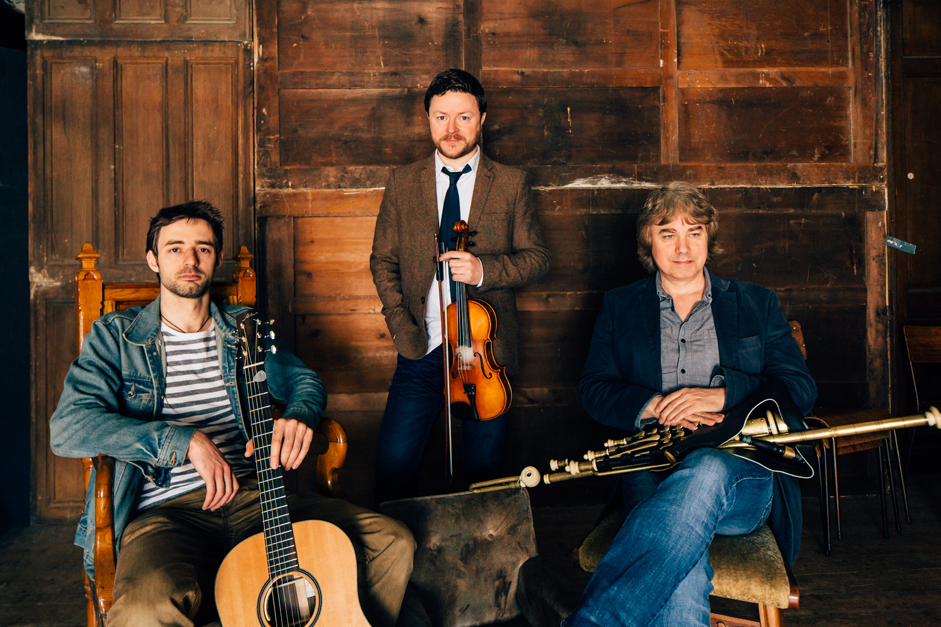
Ulaid - New Album 2015- John McSherry, Donal O'Connor & Sean Og Graham - Out Now‏!


"Ulaid features three supreme instrumentalists, gifted composers and talented interpreters of traditional and original music in one explosive package"   John O'Regan - Irish Music Magazine

"When three of Ireland's finest talents join forces on a new recording it’s time to sit up, take note and fine tune the ears. This is where the tradition is at!!"  Lynette Fay - BBC Radio Ulster / Fleadh TV

John McSherry and Dónal O’Connor are the creative force behind the highly innovative traditional band At First Light. They have toured the world extensively and produced some of the most influential albums in Irish music today. Seán Óg Graham is regarded as one of Ireland’s finest accompanists and he tours and records with the successful and dynamic group Beoga. All three are currently living in County Antrim in the North East of Ireland, and having spent many late nights in each other's company on the Belfast session scene, it was inevitable that they would come together to record at some stage. Featuring new compositions which sit comfortably alongside traditional pieces from 19th Century collections, plus fresh and progressive arrangements, coupled with occasions of free form solos, Ulaid will take you on an emotive and uplifting musical journey. From Ireland to the neighbouring Celtic regions, these three fearless musical adventurers will chart a path from the ancient music of the Gael to the contemporary shape of traditional Irish music today.

John McSherry has been a major figure in Irish music for almost twenty years, and is hailed as one of the finest exponents in the art of Uilleann Piping. Described as ‘a true master’ by the Irish Music Magazine. He is a founding member of Lúnasa, Tamalin and Donal Lunny's ground-breaking super group Coolfin. John has subsequently produced an array of critically acclaimed and innovative albums, both solo and collaborative, and continues to push the boundaries of Irish music with his current bands At First Light and The Olllam. He is a composer, producer, arranger and an established studio session musician of international renown, recording and performing with a myriad of artists including Clannad, Sinéad O'Connor, Rod Stewart, Nanci Griffiths, Gary Kemp and The Corrs.

Son of the celebrated fiddler Gerry O’Connor and much revered singer Eithne Ní Uallacháin of Lá Lugh, multi-instrumentalist Dónal O’Connor has established himself as one of Ireland’s leading producers. He has played and recorded with the likes of Grainne Holland, Moya Brennan, Steve Cooney, Mary Dillon, Cathal McConnell, Bob Brozman, Muireann Nic Amhlaoibh, John Spillane, Lumiere and Barry Kerr. Having inherited a musical legacy of at least five generations of fiddle playing he has toured the world from a young age as both a lead and backing instrumentalist with a number of bands including Lá Lugh, more recently At First Light and the Gaelic song super group A Stór Mo Chroí. He has composed music for theatre, television and film and has presented music shows for BBC ALBA, BBC NI, TG4, BBC Radio Ulster and Raidio Na Gaeltachta.

Seán Óg Graham is a guitar and accordion player who has performed and recorded with many of Irish traditional music's top artists over the last 10 years. He is a founding member of the highly acclaimed band Beoga, with whom he has recorded 5 albums and toured worldwide. He is also a talented arranger and composer, with more than 50 of his works featuring in the Beoga repertoire. Seán Óg is a first class Honours graduate of the Irish World Academy of Music and is also a member of the Scottish super group Fiddler’s Bid. His versatile and tenacious style of accompaniment is in much demand and he has performed and recorded with Grammy nominated fiddler Liz Carroll, Karan Casey, Buille, Flook, Lunasa, Máirtin O'Connor Band, and The Cora Smyth Band.

Tourdates
The lads will be touring Ireland in Oct/ Nov and will be joined by some special guests along the way.
Click here for tourdates


The Welsh "Gorsedd of the Bards"

The Gorsedd of Bards of the Isle of Britain has a long and interesting history dating back to the end of the eighteenth century.

Iolo Morganwg, an academic, originally from Llancarfan in Glamorgan, created the Gorsedd, and this happened on Primrose Hill, London in 1792. Iolo Morganwg believed that the fact that the culture and heritage of the Celts belonged to the Welsh was a fact which needed emphasising, and he believed that the creation of the Gorsedd was the perfect vehicle to reflect this.
Most members of the Gorsedd are poets, writers, musicians and artists, who either join when they win one of the Eisteddfod’s main competitions, sit an exam or when they are awarded a degree in Welsh or Music from a Welsh university.
The Gorsedd also honours some people who have worked tirelessly for the National Eisteddfod through the years – often behind the scenes, and these individuals receive the same honour as our famous faces.
New members are honoured in ceremonies held at the Gorsedd Stones on the Eisteddfod Maes on the Monday and Friday mornings of the festival week. These ceremonies are led by the Archdruid, who also leads the main ceremonies held on the Pavilion stage during the week. The Archdruid is elected for three years, and he is the Head of the Gorsedd of the Bards.
Archdderwydd

In 2009, a commemorative plaque was unveiled on Primrose Hill to celebrate Iolo Morganwg’s contribution and the creation of the Gorsedd of the Bards of the Isle of Britain.
The first link between the Gorsedd and the Eisteddfod was in 1819 at the Carmarthen Eisteddfod, and since the creation of the National Eisteddfod in its current form in 1861, a strong and close relationship has developed, with the Gorsedd playing an important role in the Eisteddfod every year.
Proposed changes to the Gorsedd of the Bards
At its recent meeting in the Blaenau Gwent and the Heads of the Valleys National Eisteddfod, the Gorsedd of the Bards discussed a radical scheme, creating the most major changes to the Gorsedd since the time of Iolo Morganwg himself.

Due to the nature and size of the proposed changes, it was decided that this matter will be discussed again in August 2011, giving the Gorseddigion ample opportunity to discuss and voice their opinions in the meantime. But what exactly is the scheme, and how is it so radical that it needs a year-long discussion before the final decision is announced?

The aim of the scheme is to ensure that everyone who becomes a member of the Gorsedd from 2012 onwards do so at the same level, thus abolishing the ‘Ovate’ and ‘Druid’ classing system. Under this scheme, the Gorseddigion would continue to wear different coloured robes, with the colours representing their specialism or talent in a specific area.

The Gorsedd is also discussing the possibility of creating a new colour, for those received to the Gorsedd on the basis of their contribution to society or the sporting world. The final decision regarding these colours has not yet been made.

Only those who have won the National and Urdd Eisteddfod’s main competitions will be awarded the White Robes in future, and the White Robes will continue to represent the special relationship between the Gorsedd and the Eisteddfod itself.

The Gorsedd is eager to ensure that new members are all accepted on the same level, and that all specialisms are treated equally, with the honour of joining the Gorsedd of equal weight across the board. These changes would also help to eradicate the idea that any one colour is more important than another. To support this, the Gorsedd has also been discussing the concept of changing the order of the colours in the Procession, and even looking again at the placing of the different colours in the Circle and on the Pavilion stage.

Additionally, the proposed scheme also stipulates that no one individual can propose or second more than three different people to join the Gorsedd in any one year.

The scheme outlined above will be further discussed at the Gorsedd’s general meeting in the Wrexham and District National Eisteddfod, next August. In the meantime, the Gorsedd is eager to encourage debate on this subject.

Anyone wishing to voice their opinions should do so, in the first instance, by contacting the Gorsedd Recorder, Penri Tanad, or completing the form below.
If the scheme is agreed in Wrexham next year, the Gorsedd hopes to introduce these radical changes at the Vale of Glamorgan National Eisteddfod in 2012, when the Eisteddfod visits the home of Iolo Morganwg himself.

Joining the Gorsedd
You can join the Gorsedd through sitting the Gorsedd Examinations, which are held on the final Saturday of April every year, in convenient centres in both north and south Wales.
Syllabuses are available in Poetry, Music, Language and Prose, and there are also specific syllabuses for harpists and in the field of Cerdd Dant. You must pass two exams in your chosen subject before you can be honoured to the Green Costume by the Archdruid in the Gorsedd Circle, but you may sit both exams on the same day. Then, the following year, you may sit the final exam, which will allow you to be honoured to the Blue Costume.
The syllabus can be downloaded from this page and includes full instructions on all subjects, including the terms and condition, the names of the examiners and the set books. The syllabus is available in Welsh as you must be a Welsh speaker to apply for the Gorsedd.
If you succeed in the examinations, you will receive a certificate designed by the late R.L.Gapper. But you will also receive the honour of becoming a member of an unique organisation which is, nowadays, an integral part of the National Eisteddfod.
For more information, contact the Gorsedd Exampinations Organiser, Dr W. Gwyn Lewis (Gwyn o Arfon), Llys Cerdd, 80 Cae Gwyn, Caernarfon, Gwynedd LL55 1LL.

Related Sources
http://www.eisteddfod.org.uk

LinkWithin

Popular Posts